
Start with the opportunity.
The guide recommends establishing commercial traction before choosing a corporate structure. A local partner should solve a defined execution problem; the right route depends on the buyer, project and scope of work.
Five questions to answer first
Use these questions to organise the first discussions and identify the information still missing.
| Question | What to establish |
|---|---|
| Buyer | Who is the customer, and which entity would sign the contract? |
| Procurement | Who controls the specification, qualification and purchase decision? |
| Regulatory route | Which import, certification, licensing or delivery requirements need to be checked for this scope? |
| Financing & payment | What is the funding source, currency, paying bank and proposed payment protection? |
| Local capability | What specific work would a local partner perform, and what capability would they bring? |
An indicative 90-day sequence
The timing is a planning framework from the guide, adapted to the assignment and availability of information.
Days 0–15
Opportunity fit
Select concrete use cases and identify the buyer problem. Start an initial review of delivery requirements and the commercial model.
Days 15–30
Route mapping
Map the buyer, contracting entity, procurement owner and funding source. Define whether local support is needed.
Days 30–60
Qualification
Assess potential partners and coordinate checks on approvals, delivery, payment and specialist issues.
Days 60–90
Commercial preparation
Prepare qualification materials and the offer, then align logistics, staffing, commercial terms and follow-up.
Choose a route that fits
The guide considers direct supply, importer-distributor arrangements, commercial representation, operator and EPC supply chains, and local establishment. These are options to assess against a specific opportunity, rather than a single model for every entrant.
Original publication files
Download the original documents in the available languages. The PDFs retain their own purpose-of-use and professional-services limitations.
English · 17 pages · PDF
The roadmap helps an international company turn an interest in Turkmenistan into a defined commercial opportunity. Five entry tests examine the buyer, procurement route, regulatory requirements, financing and local capability. The guide compares routes to market, local partner options and 14 sector routes, then sets out an indicative 90-day sequence. An investor and exporter checklist brings together the questions to address before committing resources.
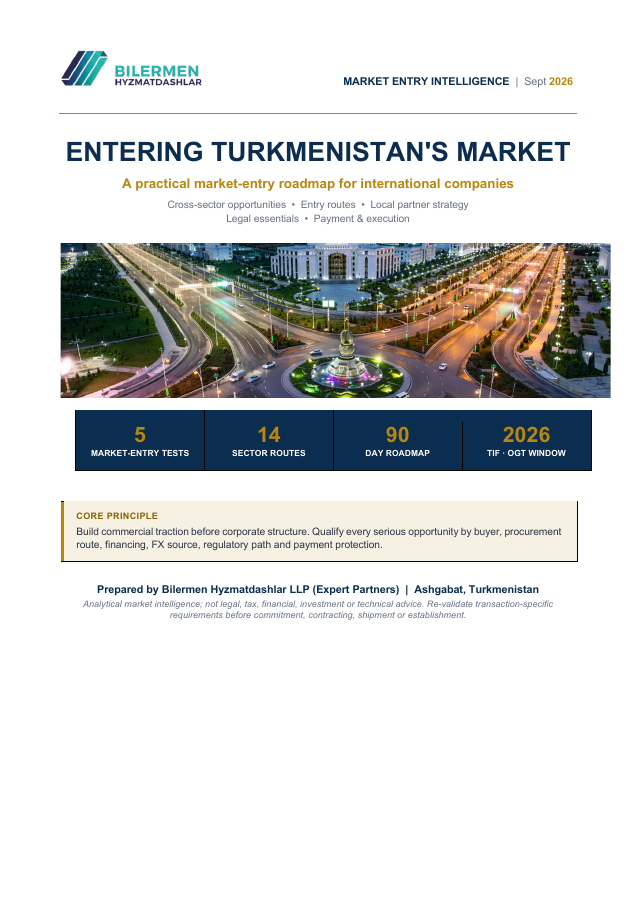
This overview is adapted from Bilermen Partners’s September 2026 publication. It introduces the framework; transaction-specific legal, tax, financial and technical questions require appropriate specialist review.